
Cryptocurrency enthusiasts and blockchain maximalists have long sought to build their own utopia.
Ideas on how this would take shape have changed as the crypto industry and its influence have grown globally. From small communes in Norway, non-starter crypto company towns in Nevada, and micronations in the Balkans.
In 2022, Balaji Srinivasan, an American entrepreneur and former chief technology officer of crypto exchange Coinbase, published his book The Network State. In it, he posited a new model for governance, namely “a highly aligned online community with a capacity for collective action that crowdfunds territory around the world and eventually gains diplomatic recognition from pre-existing states.”
The ideas have caught hold among prominent members of the crypto community and libertarian-minded tech moguls. Some have already begun organizing, with projects like the Bitcoin City in El Salvador already securing the tacit support of national governments.
But as the idea gains ground among the tech elite and the crypto curious, critics are emerging. Those opposed to, or at least skeptical of, so-called network states are noting concerning, familiar historical patterns and the possibility of a digital oligarchy emerging.
Building the network state
The network state presents a vision of a political body that isn’t necessarily all in one physical location, but rather consists of like-minded individuals using technology (read: blockchain technology and crypto) to form a society distributed across the globe. According to Srinivasan, you might be able to track it across a dashboard that looks something like this:
Is the Network State concept practical?
While the Network State concept intrigues many in crypto — who already work in an imagined community connected over the internet — it has been criticized in some quarters as “tech fascism” and by others as idealistic and impractical.
Erik Zhang, the founder and core developer of NEO, took aim at the Network State concept, saying, “No state can be held together by a single value alone.”
He wrote that “nation-states are messy because they must balance education, healthcare, economy, justice, culture, and conflict resolution.” Network states will eventually face the same difficulties once they scale. “Contradictions don’t disappear — they just explode later.”
Zhang also questioned whether the “one commandment” principle of the network state, that there is one unifying principle, is even possible beyond the startup phase.
The concept is yet to be proven in practice. Some 200 network state experimenters came together in Montenegro in 2023 to form an intentional community called Zazulu. Guided by Ethereum co-founder Vitalik Buterin — who is intrigued and inspired by Srinivasan’s ideas — the experiment was intended as a proof of concept for the network state.
The participants were meant to live and work together, engaging in healthy eating, cold plunges, and yoga to get a sense of what challenges might arise.
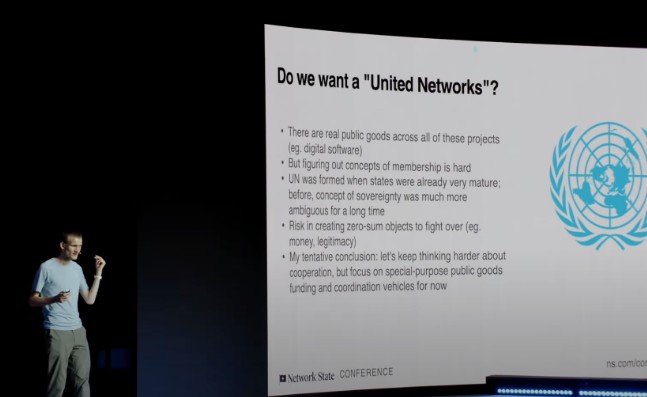
But in 2024, Buterin indicated it had not been an unqualified success and said it was “unclear what immediate next step Zuzalu implied.” He said that there needed to be a clear goal and mechanisms to address tribalism between network states, which he called “zero-sum and unproductive.”
Joel Garrod, a sociologist at St. Francis Xavier University in Canada, in a December 2024 paper, characterized the network state as a “a likely-to-fail libertarian exit project,” the foundational text of which “shares an elective affinity with a larger, and more generalized, struggle to make a global property regime.”
He said that the feasibility isn’t even necessarily the point. “While many of these texts, including The Network State, have been dismissed as outlandish or ‘batshit crazy’ […], their striking influence on contemporary politics and their widespread visibility make them necessary objects of critique and engagement.”
Liberland
Since the Bitcoin whitepaper was published in 2008, various cryptocurrency-aligned experiments with state-building have been attempted, albeit not exactly in the order outlined in The Network State.
In 2015, Czech right-wing libertarian politician Vít Jedlička claimed an island in the Danube River between Croatia and Serbia as Liberland. The piece of land was claimed by neither nation after the river was diverted in the 19th century.

Liberland has an engaged community online and uses blockchain technology to secure its governance tokens, Liberland Merit. Its main unit of exchange is another token, the Liberland Dollar.
While Jedlička has claimed the territory under the principle of terra nullius, attempts to inhabit the land have been unsuccessful, with border guards frequently intercepting attempts to land on the island.
Liberstad
In Norway, activists have formed Liberstad, a community compound on private land near Lindesnes.

It was founded on anarchist and voluntaryist principles, and the cryptocurrency City Coin (CITY), which it adopted in 2019, serves as the sole means of exchange. Different tiers of membership, paid in Norwegian kroner, confer different benefits, including deals on stays and the ability to affect decisions within the Liberstad.
Próspera
Próspera, a small community on the Honduran island of Roatán, was founded in 2020 with plans to offer a low-tax community with yearly citizenship dues under the Zones of Economic Development and Employment established in 2013.
According to the MIT Technology Review in 2022, investors including billionaire Peter Thiel, venture capitalist Marc Andreessen, Bitcoin activist Roger Ver and Srinivasan had invested $50 million into the project.

The project soon came up against residents of the nearby village of Crawfish Rock, who claimed that Próspera falsely represented it as a regular tourist development to secure their consent to develop nearby. Residents reportedly worried that the project would attempt to make a landgrab.
While Próspera has said it could not take the land, either itself or if it were seized by the government, activists and residents were uneasy. Rosa Daniela, a community activist, told the MIT Technology Review that Próspera “respects no government, no rules, no law; just a dream.”
Storey County
Other projects were nonstarters. In 2021, blockchain incubator and investment firm Blockchains LLC attempted to build its own city by buying 67,000 acres of desert land in Storey County, Nevada, for $170 million. The land was supposed to be turned into homes and business parks, where everything from salaries to everyday goods and services would be paid for in crypto.

The plan was ultimately scuttled. Firstly, the would-be community didn’t have a stable water source and would require a 100-mile pipeline, which, according to Kyle Roerink, executive director of the Great Basin Water Network, would be “a very long process, likely with a lot of litigation involved.”
Secondly, and more importantly to its connection with network states, the company sought to change Nevada law and create “innovation zones.” This would allow it to operate like a county government, creating courts, making land and water use decisions, and even levying taxes.
This would have made Blockchain LLC’s project essentially a company town, a prospect about which no one was enthused, but to which the hypothetical network state bears a glaring resemblance.
Read also
Features
You Say You Want a Revolution: What Blockchain Can Learn from One Man’s Attempt to Save the World
Features
The Lizard People Invented Bitcoin: Crypto is a Hotbed for Conspiracy Theories
Growing pains and the new company town
There is nothing new under the sun. Company towns formed around a simple economic goal have surfaced at multiple points in history, and some rather recently.
The British East India Company fought wars with its own private navies and armies and established colonies in India, Pakistan, Bangladesh and Myanmar. The US’ United Fruit Company lobbied the CIA to support a coup in Guatemala to protect its massive interests, which included vast tracts of land, railroads and ports.
In the mid-20th century, in mining company towns in West Virginia, losing one’s job also meant losing one’s home. Struggles for unionizing and basic housing rights versus the company’s paid private police force, including their own armored train, led to the Battle of Blair Mountain, the largest armed conflict in the United States after the Civil War.
While no one has yet suggested that the network state wishes to use the same methods to exert influence on an economy, some observers have noted that major corporations or small groups of very rich people can put their thumb, rather heavily, on the scale.
Association of Chartered Certified Accountants chief economist Jonathan Ashworth said, “The notion of a corporation or a wealthy individual founding a ‘nation’ could perhaps sound appealing to some, particularly if established in poorer developing countries or island nations.”
“Host countries might be initially attracted by promises of investment and expertise. However, any significant success by such ventures would likely prompt concerns about a loss of power or influence, especially if they became overly independent or began to involve themselves in the wider political discourse.”
Read also
Features
You Say You Want a Revolution: What Blockchain Can Learn from One Man’s Attempt to Save the World
Features
The Lizard People Invented Bitcoin: Crypto is a Hotbed for Conspiracy Theories
Liberia and Utah are communities built around common goals
Still, intentional communities around a common goal have been able to establish themselves. Divya Siddarth, the cofounder and executive director of the Collective Intelligence Project, notes that Liberia was founded by freed American slaves who “sought to ‘colonize’ Africa to escape from racial oppression.”
“Utah was settled by Mormons with markedly different lifestyles fleeing persecution; Israel was the ‘hope of 2000 years’ of Jewish history; more recently, the Islamic State is arguably the closest analog to the network state.”
Like any novel idea, whether it be for good or for bad, the digital network state will be subject to much scrutiny and skepticism. Whether it can form a truly new model of governance for human beings, rather than a digital reiteration of the past, remains to be seen.
Subscribe
The most engaging reads in blockchain. Delivered once a
week.


Aaron Wood
Aaron Wood is a Cointelegraph staff writer and senior features writer covering cryptocurrency-related policy, regulation, politics, and energy usage. Aaron holds degrees in Political Science and Economics. Previous to working at Cointelegraph, Aaron worked on election campaigns for the Democratic Farm-Labor Party in Minnesota and was a managing and technical editor at the ENERPO newsletter and academic journal at the European University in St Petersburg. Aaron holds Bitcoin and Ethereum above Cointelegraph’s disclosure threshold of $1,000.
Disclaimer
Cointelegraph Magazine publishes long-form journalism, analysis and narrative reporting produced by Cointelegraph’s in-house editorial team with subject-matter expertise.
All articles are edited and reviewed by Cointelegraph editors in line with our editorial standards.
Content published in Magazine does not constitute financial, legal or investment advice. Readers should conduct their own research and consult qualified professionals where appropriate. Cointelegraph maintains full editorial independence.
Read the full article here