The battle for control of the House of Representatives this fall will be decided by a small fraction of the chamber’s seats. Republicans are clinging to a three-seat majority, the narrowest margin in modern times.
The nation’s political climate is volatile, and much can change between now and November. But at the start of the year, only a small number of seats are seen as genuinely competitive, magnifying the stakes of individual House races that routinely cost tens of millions of dollars.
The clearest Democratic pathway to a majority — and the power to serve as a check on President Trump and his legislative agenda — is defending the party’s most vulnerable incumbents and flipping a handful of Republican-held seats.
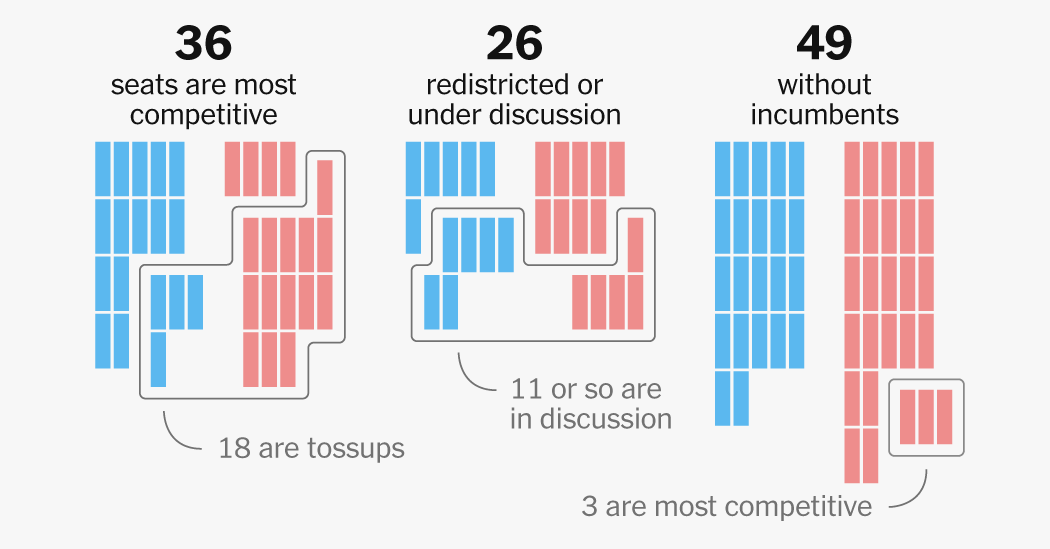
These 36 districts are the most competitive in the battle for House control.
Seat held by a •Democrat •Republican
197
solid or likely Democratic districts
202
solid or likely Republican districts
14
Lean Dem.
18
Tossup
4
Lean Rep.
•
•
•
•
•
•
•
•
•
•
•
•
•
•
•
•
•
•
•
•
218 seats for control •
•
•
•
•
•
•
•
•
•
•
•
•
•
•
•
Today, the Cook Political Report rates just 18 seats as tossup races — four held by Democrats and 14 by Republicans. But the map is evolving and Cook recently shifted 18 House races in Democrats’ direction, a sign of the party’s momentum and Mr. Trump’s struggles.
Of the House’s 435 seats, the vast majority, 375, are rated as “solid” for one party or the other — meaning they are essentially noncompetitive. Another two dozen races are seen as likely to favor one party, while 18 are in the more competitive “lean” category.
The magic number for a House majority is 218 seats.
To get there, Democrats would need to hold all of their solid and likely seats, sweep the 13 seats that lean toward their party and win at least seven of the 18 tossups, according to Cook’s ratings.
The initial 2026 House battlegrounds do not span the whole nation. The South and the Mountain West are mostly afterthoughts, though Democrats hope some strong candidates in those places could make more seats viable.
Other factors are at play for House control, too:
Redrawn maps scramble the midterm forecast
Possible change
Change
Actions taken to redistrict
Discussed but less likely
Many states have redrawn their maps after Mr. Trump set off a nationwide gerrymandering fight. Typically, House districts are drawn once a decade, after the census. But Mr. Trump, wanting to defend his party’s slim House majority, sought an edge by pressing for so-called mid-decade redistricting in red states.
He has already pushed Texas, Missouri and North Carolina to draw new maps, carving out as many as seven more Republican districts. Ohio had to redraw its map by law, and its new lines favor Republicans more, but to a lesser degree than some Democrats had feared. In Indiana, Republicans stunningly rejected Mr. Trump’s effort.
In response to Texas’ move, Gov. Gavin Newsom of California persuaded his state’s voters to approve a plan to carve out five Democratic seats and shore up vulnerable House Democrats.
More new maps could be coming: Democrats are pushing to redraw lines in Virginia and possibly New York, and Republicans are considering new lines in Florida. Other states like Maryland and Nebraska have had discussions about redistricting but have made limited progress.
There is another X-factor: The Supreme Court is considering a case that could sharply weaken Voting Rights Act protections for districts drawn to purposefully help voters of color elect candidates. Such a decision could set off another round of redistricting and eliminate a range of Democratic seats in the South.
And as all of this is happening, many lawmakers in both parties are heading for the exits.
A wave of retirements concentrated in solid districts
At least 49 districts will not have an incumbent running in the midterms.
Seat held by a •Democrat •Republican
21 Solid/likely Dem.
•
•
•
•
•
•
•
•
•
•
•
•
•
•
•
•
•
•
•
•
•
25 Solid/likely Rep.
•
•
•
•
•
•
•
•
•
•
•
•
•
•
•
•
•
•
•
•
•
•
•
•
•
The Congress that will be sworn in next year will look very different, regardless of which party controls each chamber. More than 10 percent of lawmakers in the House have already announced they won’t be running for re-election.
But those retirements — including those who are forgoing re-election to seek higher office — are heavily concentrated in safe seats.
The two clearest exceptions are Representative Don Bacon of Nebraska, a Republican in a seat that Mr. Trump lost, and Representative Jared Golden of Maine, who had held the most pro-Trump seat of any Democrat. Both seats are now seen as more likely to flip.
Two other Republicans who decided to run for governor of their states, Representative John James in Michigan and Representative David Schweikert in Arizona, have opened up competitive seats, as well.
Read the full article here